
Learn The Power of Educational Marketing
0 comments Posted by Charles Brown at Monday, December 29, 2008Whether you sell a product or a service, you will put yourself miles ahead of your competition if you include an education element to your marketing process. This is why white papers, case studies, informative web content and ebooks are such popular and powerful marketing tools these days. It is also why many marketers find themselves in front of audiences giving speeches, seminars or workshops.
The fact is that companies or professionals who take the time to educate and share their knowledge can establish a much higher level of credibility in their customers’ eyes than those who simply go after the sale.
But what about educating customers and clients after the sale?
I found myself thinking about this after reading John Jantsch’s recent article Teach Your Way To Referrals in his blog on Duct Tape Marketing. (By the way, if you aren’t reading Duct Tape Marketing yet, you are missing out on a wealth of great ideas and information).
Jantsch makes the excellent point that after sale education efforts pay off big time in referrals, and I would also add repeat business.
This is simply not that hard to do. I am working with a client right now who has asked me to create an ebook and email marketing campaign for sales people who use his products. Without revealing confidential information, his products help a variety of sales people and small businesses generate leads.
The ebook he wants me to write is going to be a free, downloadable educational product that will give his prospects marketing tips and ideas. And once the ebook is downloaded, the prospect will receive regular emails that offer more tips and advice. (I'm sure you will recognize this as a classic "Permission Marketing" campaign).
Similarly, you can easily find a variety of ways to communicate your own knowledge and expertise to your target market and existing customers. It isn't a difficult process, just identify the problems customers want to solve or questions they ask (or better yet, look for the questions they should be asking but don't yet know enough to ask them). Create simple info products or presentations that address these hot buttons and you have an educational marketing campaign.
Jantsch puts it this way:
I know I love it when I get buy a product and the first thing I receive is a getting started guide, followed by a full tutorial, followed by daily “have you tried this” emails. Every business, product or service can do the same.
Check out his article at Teach Your Way To Referrals, and if you are not already reading his blog, start doing so now. You’ll thank me later.
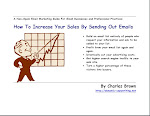
And one more thing. If you would like to learn more about this educational approach to marketing, be sure to download a free copy of my own ebook, How To Increase Your Sales By Sending Out Emails. You will read about other businesses that have gotten excellent results by educating their customers and prospects.
COPYRIGHT © 2008, Charles Brown

 Add to Onlywire
Get Your Own "Joe The Plumber" - Why Stories Sell
0 comments Posted by Charles Brown at Saturday, October 18, 2008I suspect Joe Wurzelbacher was ready to fall out of his chair Wednesday night when John McCain used him as an example of why he disagreed with Sen. Barack Obama's tax plan.
Wurzelbacher, aka "Joe the Plumber," has become an instant celebrity after he asked Obama a question about how the candidate's tax plan would effect him.
But my point here is not to discuss politics, but how putting a face to your ideas and issues can propel them far beyond mere facts or figures can. What McCain did was nothing more complicated than to tell the Ohio plumber's story as a way of getting his political message across.
All of us have messages we want to convey. In business, one of the most compelling stories any company can tell is about quality.
- Why do your building materials save energy costs?
- Why do your burgers taste so great?
- Why do your clients gain so much more than your competitors' clients?
Another persuasive story form is the success story.
Success stories are small vignettes about real people your products or services have helped. They focus on how these people were able to solve their problems because of a business relationship with your company.
Success stories are extremely powerful for the same reason Joe the Plumber's story is a better way to illustrate tax plans. Few of us understand the inner workings of economic policy (although lately it could be argued that we are all becoming experts), but we do understand about people.
When I read about a client who overcame a serious legal problem because of the hard work of his lawyer, I understand (and more importantly, I believe). When I read about a good marriage counselor that was able to help a couple work through their problems and save their marriage, I cheer them on and I form a bond with the people this story was about.
Stories sell because they communicate on a gut level. They let us experience the emotional joy of witnessing a problem being solved and a stressful situation overcome.
So the lesson here is to go out and find your own "Joe the Plumber" story that you can use to help communicate your message. Illustrate your facts and figures with real life examples using real people. Put faces to your communications and they will resonate.
COPYRIGHT © 2008, Charles Brown
Add to Onlywire
As I listened to Hillary Clinton's speech last week in the Democratic Convention (I know, I have been drawing a lot of marketing lessons from the presidential race, but I promise not to turn this into a political blog), I was struck by how often she weaved "case studies" into her speech.
She talked about a single mom who had adopted two children with disabilities and then lost her job. She also talked about a young marine who was worried about his buddies who were still over in Iraq. And she talked about people who were worried about getting needed healthcare for their families.
I've noticed that Mrs. Clinton has done this often over the course of this campaign. The people she talks about are real people she has met along the campaign trail.
Ronald Reagan did this too. Many of his speeches were laced with stories about actual people who were facing incredible challenges.
And you have to admit that regardless of your political persuasions, the use of these "case studies" makes for effective communications.
Now let me tell you the wrong way to do this. There is a personal injury lawyer who advertises extensively here in the Dallas / Fort Worth area. Imagine the most annoying, most grating lawyer ads you've ever heard. Well this guy is worse.
He calls himself "The Texas Hammer" and he promises to "fight for you to get you the money you need." (Sigh).
Anyway, he also lists some of the recent cases he has one. Well actually he lists the dollar amounts of the awards he has won. He tells very little about the clients themselves as human beings. He might say they injured their leg or wrist or whatever, but no information about them as people that would make us sympathize with them or relate to them.
In other words, they are presented as dollar figures, not as people who were helped out of a difficult problem.
Don't make this mistake.
I've seen a lot of case studies that do the same thing. The subjects are presented as cardboard, lifeless characters who are little more than extras in their own movie.
But readers want to connect with the people they are reading about. Allow readers to experience the emotions and problems of your case studies subjects. Delve into their fears, the raw emotional nerves of their troubles. THEN when you show how they escaped from these problems, the reader will cheer for their happy ending as they would for a dramatic movie.
Hillary won 18 million votes, and I have to wonder if a lot of them were a result of her ability to tell compelling stories about our fellow citizens. And if it works in politics, it will also work in business.
COPYRIGHT © 2008, Charles Brown
Don't Alienate 69% of Your Potential Clients
0 comments Posted by Charles Brown at Friday, August 29, 2008I just read an article by Erica Stritch in Rain Today that 69% of buyers who are considering hiring a professional services firm will visit a company's web site before making a decision to do business.
This statistic just adds one more compelling reason to make sure your web site delivers the kind of content that will engage and persuade your visitors.
The days of just slapping up a brochure on the web or filling your site with empty "mission statement" language are over (if they ever exited). Whether you are a professional services firm or not, the point is that you cannot afford to make your web site an afterthought.
How can you make your site engaging and persuasive? Here are a few ideas"
- Pay attention to the search terms people typed into a search engine that led visitors to your site. This is a great clue to tell you what people are looking for and what questions they want answered. Make sure your site delivers this information.
- Build your site around what your visitors want to know, what problems they want to solve or what questions they want answered - rather than what you want to sell. Check out my article You're Really Just Selling Aspirin for more on how to do this.
- Make sure the home page offers visitors clear choices to click based on those questions they want answered or problems they want to solve that I mentioned above. It is fine to have product or services choices for those who have already visited your site or who are ready to buy, but most people want information first.
- Do I have to mention benefits? Of course I do because 90% of web sites I visit are written by people who wouldn't know a benefit if it bit them on the nose. If you have trouble distinguishing between features and benefits, substitute "solutions," "answers" or "changes" for the word "benefit."
- Use your site as a lead generation machine. Give visitors a reason a REASON to give you their email address. Offer something valuable and free (usually some information product words best). Most people will not return to your site unless you contact them later with more of the information they sought in the first place.
- What you say in your meta tags does matter. True it has little impact on getting search engine traffic, but it is also what people see when your site comes up in their search results. This will go a long way toward getting them to click onto your site. BUT it also tells them what to expect when they arrive, so don't le them down.
- Include case studies. The actual success stories of your existing customers will not only give people confidence about doing business with you, it will help them understand what you do and what problems you can solve.
None of us can take for granted the importance of our web sites. When over two-thirds of our potential clients check us out online as part of their decision-making process, no business can afford to gamble with a bad impression.
COPYRIGHT © 2008, Charles Brown
Add to Onlywire
If White Papers and Case Studies Were Siblings ...
3 comments Posted by Charles Brown at Wednesday, August 20, 2008If white papers and case studies were siblings, the white paper would be the older, serious-minded member of the family, while the case study would be the younger, creative one who tends to color outside of the lines.
And yet, I would argue they are both members of the same family and are essential tools in making a complex sale.
Imagine you are an executive with a company that needs to buy a software program to solve certain problems. Your job depends on your due diligence and your attention to detail. When you make your presentation to the board, you had better have all your facts together with every possible "i" dotted and "t" crossed.
But that said, buying decisions, even at that level, are based on emotions.
This is why companies that only produce white papers, or companies that produce dry "business school style" case studies are missing the point. Even high-level board members are people too with all the emotions of an individual consumer.
I am constantly urging my clients to include fiction-writing techniques like suspense, characters and plots into their case studies. The more your case study looks (and more importantly feels) like a feature article the better.
In fact if you want an example of what a really effective case study should look like, read the Wall Street Journal's middle column on its front page for a week. All of these middle column articles are features and many of them are case studies about companies that overcame - or are presently struggling with - serious challenges.
And they almost always include characters, suspense and plots.
Stories sell. But dry, emotionless case studies of the type many marketers learned in business school, are a kiss of death. The writers of such case studies might as well have just written another white paper. But then, the white paper format does a far better job of presenting purely factual information.
If you only want to appeal to the buyer's logical side, you are better off sticking with white papers.
So use the combined power of both "siblings" in your marketing. Let your white papers distill raw information, present the hard facts and persuade by logic and reasoning.
And let your wilder, creative case studies color outside the lines a little bit.
COPYRIGHT © 2008, Charles Brown
A Sign Company Uses Storytelling to Build Their Brand
0 comments Posted by Charles Brown at Tuesday, August 19, 2008I just read a really great article by John Jantsch in his "Duct Tape Marketing" blog that shows how storytelling can be used to promote even the most unlikely of products.
The article, which is called Blogging Customer Stories, is about a New Hampshire Sign Making company named Lincoln Sign Company.
What Lincoln Signs does that is unique is they blog about the process of creating custom signs for their customers. As they put it, "we are using our blog to sell the EXPERIENCE of getting a sign.” As they blog about a customer's sign, they are, of course, giving the customer additional exposure, but they are also creating a case study about the sign and the details of making it.
For Lincoln Sign Company, they benefit because they create web content, get traffic from search engines, and enhance to value of their signs. Here are some more quotes from Lincoln Sign Company's blog:
"It has been said that the best marketing one can have is for a customer to want to tell your story to someone else. We want to provide a tool to help people tell a story about your business."
“At the end , you get more than a sign, you get a sign, AND the story of how that sign was made.”
"Telling the story of these signs being made educates a potential customer about the process and care that is taken in presenting their "brand" to the world. There are days we wish we could give anyone thinking about purchasing a sign a tour of our shop, and this weblog is our opportunity to do just that."
COPYRIGHT © 2008, Charles Brown
Many non profits have learned that case studies and stories are great ways to promote their cause. Stories about impoverished children being fed and receiving medical care, or disaster victims getting new homes and a chance to start over, or orphaned and abandoned children being adopted into loving homes, all make compelling ways to present the non profit's mission.
But what about donors and volunteers?
Don't think for a moment that the people who write checks or those who hammer nails under a hot sun, don't receive great rewards for what they do.
These people have compelling stories too that can be used to raise more funds and enlist more volunteers.
Think for a moment what donors and volunteers "get out of" their experience with a worthy non profit cause. Here are two that come to mind right away:
- The emotional benefits can be life changing. I read about Prince William of England and how he spent one summer several years ago cleaning toilets and serving impoverished communities in South America. In an interview, he literally gushed about how the experience had made him a new person.
- The reputation building can be dramatic. Again, I have to think that the image of Prince Will cleaning toilets had to be the best "PR" the future monarch could ever have. I don't at all mean to be cynical here, but I cannot doubt that the British people have never looked at the young prince in the same way since. Imagine how beneficial such publicity might be for a person or company in need of great publicity. You literally cannot buy advertising that works as well.
Non profits have important stories to tell. Although many use the dry old "just the facts" way of telling about their mission, enlightened non profits are learning to tell it with stories and case studies.
COPYRIGHT © 2008, Charles Brown
Add to Onlywire
Don't Wear Out Your References - Use Case Studies Instead
0 comments Posted by Charles Brown at Saturday, August 16, 2008Casey Hibbard just wrote an article on her blog called, Relieving reference customers - Give 'em a break!, that opened my eyes to a new reason companies need to be using case studies.
When we've done good work for a customer, all of us naturally want to use that business or individual as a reference. The customers, for their part, are still feeling a warm glow as a result of your product or service finally solving their problem. So they just as naturally agree to be your reference.
So far so good.
But what happens when that customer starts getting 10 to 50 calls a week? Not so good.
Naming a satisfied customer as a reference produces short term rewards because that customer will eventually weary of telling prospects how wonderful you are ... especially when the mere mention of your company is beginning to send them diving under their desks.
In the course of writing many a case study, Casey has discovered that many of these satisfied customers are GLAD to be the focus of a success story because it means these phone calls will finally come to an end.
Want to keep your best, most satisfied customers' stories fresh and compelling? Then turn their experience into a case study, and give them a break on all the reference telephone calls.
Check out Casey's article at: Relieving reference customers - Give 'em a break!
COPYRIGHT © 2008, Charles Brown
Are Yellow Page Ads Trash? Do They Have To Be?
1 comments Posted by Charles Brown at Thursday, August 07, 2008Larry Bodine, who writes the Law Marketing Blog wrote an interesting piece this week called, Evidence That Yellow Pages Are Trash.
As you probably know, lawyers and law firms are among the most prolific Yellow Page advertisers. Larry mentions that in his local pages, lawyer ads run from page 497 to 538, with little to distinguish themselves other than pictures of gavels and scales of justice.
Sigh. This means I am going to have to get on my lawyer-marketing soapbox again.
As many of you know, I used to be a lawyer and one of my peeves is how poorly lawyers and other professionals market their services.
Frankly I believe this is one of the reasons practicing law is such a high-pressure profession. Poor marketing leads to taking on bad clients with bad cases who leave swaths of stress and frustration in their wake. Many of the cases and clients in a lot of lawyers' files are there simply because they couldn't afford to be selective.
Good marketing enables all professionals to be selective and lets them work with the people they really want to work with.
Back to Larry's article. Larry looked out his window one morning and saw what appeared to be a bag of trash laying in his front yard. When he went out to throw it away, he found it was the local Yellow Pages. His point is that the lawyers who bought expensive ads probably would not have preferred to have it presented as trash in someone's front yard.
I will grant Larry's point that Yellow Pages could be presented much better, but my mind took what he said and went off on its own direction. I believe Yellow Page advertising could be productive for professionals if they were handled better.
Instead of cookie-cutter ads with gavels, scales of justice or pictures of stern looking lawyers, why not use these ads to offer free information kits on different areas of the law?
For example, if I were looking for a lawyer to handle my medical malpractice case, do you think I would be attracted to an ad that listed medical malpractice within a laundry list of other specialties? Or do you think I would gravitate to an ad that offered a free booklet or case study on medical malpractice?
This is the difference between one-step vs. two-step advertising strategies.
Decades of direct response advertising and generations of copywriters have proven that two-step advertising, in which a person merely has to request free information, almost always gets a higher response.
Alternatively, a one-step ad which requires that the person must call a phone number to schedule an appointment, requires much more of a commitment on the person's part, and therefore gets a much lower response.
Two-step advertising requires less of an initial commitment on the part of the potential client, but gives the firm the opportunity to build a list of prospective clients and follow up with these people with subsequent mailings or emails.
These days, the term, Permission Marketing is used interchangeably with "two-step advertising." The ad's sole purpose under this strategy is to gather a list of prospects and follow up with them by offering valuable, free information. Repeated contact with potential clients who have opted onto a list invariably converts more of them into actual clients.
What kind of information can be offered both as the initial inducement to opt in or as follow up material? Problem-solving information pieces like white papers, list articles, FAQs, or case studies all make excellent free info products.
The added benefit with these materials is that they all position the lawyer or other professional as an expert in that area of their practice. They go from someone who just mentioned "medical malpractice" as one of several areas within a laundry list, to someone who is knowledgeable enough to have written material about it.
So, Larry Bodine's point is very well taken that Yellow Page ads may lack a lot in their presentation, but I would urge professionals who do Yellow Page advertising to simply write ads that are intended to build lists of prospective clients.
COPYRIGHT © 2008, Charles Brown
An Interview With Casey Hibbard on Writing Case Studies
0 comments Posted by Charles Brown at Monday, August 04, 2008Last week I had the pleasure of interviewing Casey Hibbard about her experience and views on writing b2b case studies. Casey has written over 450 "customer success stories," as case studies are sometimes called, and also writes about how to use case studies as b2b marketing tools on her blog, Casey Hibbard's Stories That Sell.
Q: What kinds of companies have you written case studies for?
A: 90% of my customers are high tech companies,mostly software companies. I have also
written and managed case studies for non-tech companies like consultants, non-profits, insurance and employee benefit companies. I also have a client that is a
tree care company.
Q: A tree care company?
A: Yes, they were originally the customer and subject of another company's case study and liked the idea. They now use case studies to show how they handle tree care for large companies.
Q: What advice can you give a company that has never used case studies but wants to promote itself?
A: There are dozens of ways to use case studies. One company I know uses very short customer success stories that fit on post cards they send out. The Make-A-Wish Foundation plays recordings for callers that are on hold of children telling about their wishes being granted.
Of course, case studies also make good web content, and handouts for trade shows. They make excellent PR materials, but for some reason they really are
underused as PR pieces. Also, I know a graphic design company that no longer uses a brochure and instead shows customers a printed booklet full of customer success
stories.
Q: Why do you think case studies are so persuasive when other marketing tools like advertising and direct mail have difficulty producing results?
A: I wrote an article on my blog recently about what kinds of communications people trust. First were the recommendations of friends and family. But the second most trusted form of business communication was "strangers with experience." Case
studies fill a niche that nothing else can fill (credibility, education and validation). Many other forms of business communication have one or two of
these elements but not all three.
Also we all love to read about people. Stories also bring abstract concepts like technology to life. A reader can see a solution in action when they read a story.
Contrast this with a brochure, where readers may have difficulty picturing how it might help their situation.
Q: There are two schools of thought when it comes to writing case studies. One uses the traditional business school format of challenge, solution and results. The other recommends writing case studies that resemble magazine or newspaper feature rticles.
Which do you believe is most effective?
A: Definitely the feature article format. I try to move clients away from using the traditional format and toward something that more resembles a story. An added advantage to the feature story is that it makes the case study a better PR tool. Media outlets are more likely to pick them up if they are in a form that is more interesting to their readers.
Q: I understand you have a book that will be out soon, can you tell us about it?
A: It is called, "Stories That Sell: Turn Satisfied Customers into Your Most Powerful Sales & Marketing Asset," and it will be coming out this fall. I try to cover the complete process of writing customer success stories, from identifying the best customers to write about, how to approach these customers, interviewing, managing the approval process, using the stories. I spent a year interviewing companies about their best practices and have included about 20 stories of companies that have been successful using case studies. It comes out this fall.
COPYRIGHT © 2008, Charles Brown
WANTED: Success Stories on Success Stories
0 comments Posted by Charles Brown at Thursday, July 31, 2008If you haven't checked out Casey Hibbard's blog on case studies, Casey Hibbard's Success Story Marketing, you will find it to be a wealth of really useful information on how to market any product or service using case studies and customer success stories.
Right now she is wanting to collect examples of companies that have successfully used their own customers' success stories to promote their businesses. In other words, she is gathering case studies on successful uses of case studies.
Here's what she needs:
-- Examples of creative, unique uses or formats for customer stories. Not just your ordinary web site or sales use.
or
-- Examples of stellar results with customer stories - with any type of use. Maybe your business added customer stories and have seen more web site traffic, more upsales, more cross-sales, or bumps in sales in a certain vertical market.
If you have these examples you would like to share with her, send them to casey@compelling-cases.com.
COPYRIGHT © 2008, Charles Brown
Add to Onlywire
I just ran across the following article by marketing guru and the father of the concept of "positioning" in the marketplace, Jack Trout, called Greatest Stories Never Told about marketing stories that you never hear of. The organizations he mentions, Wal Mart, Southwest Airlines,SKF, the Bestty Crocker division of General Mills, Papa Johns Pizza and even the Democratic Party are fascinating, but these organizations seem to not realize the power of actually telling these remarkable stories.
Religions also spread their messages with stories. While I'm not familiar with Islam and Hinduism, I do know about Judaism and Christianity.
Christianity is based entirely on the story of Jesus' life, death and resurrection. While he was alive, Jesus himself spread his message with stories he called parables.
Judaism tells and retells its great stories too. During the Passover holiday the story of Moses leading the people of Israel out of Egyptian captivity is told to hearers who realize this one story sums up what it means to be Jewish.
If religions spread their messages with stories, why aren't business organizations? Does your company nit pick over quality issues? Then there is a powerful story there.
Does your company take great pains to service the customer after the sale? Then tell this story too.
How about product development? Tell the story about how your company spends time, money and manpower to make sure your new products have no equal in the marketplace.
Do you have lots of satisfied customers who overcame big problems as a result of doing business with you? Tell these stories in the form of case studies and get the word out in press releases, print ads, presentations, or your web content.
What other business stories are out there? Give me your feedback with examples of great stories that need to be told.
COPYRIGHT © 2008, Charles Brown
Why Do Stories Succeed in Making Us See Past Our Own Biases?
0 comments Posted by Charles Brown at Saturday, July 26, 2008One of the things that happens to us as we go about our task of daily living, is that we build mental constructs of our world based upon how we interpret our experiences.
For example, I really struggled with my grades through high school and barely made it to college. I had the ability, but I lacked any belief in myself as a student.
This lack of belief was a construct I had created in my mind.
Annette Simmons, in her book, The Story Factor, illustrates another type of construct.
She was at a storytelling festival in 1992, standing next to a rough-looking man who illustrated the power of stories for her. When a young black man got up to speak, the rough-looking man uttered a racial epitaph under his breath, folded his arms in front of him and stared away from the speaker.
But as the young man spoke and told his stories, something changed. The rough-looking man became deeply involved with what the young man spoke about and ended with tears in his eyes.
In a sense, this man is like our would-be customers. They may have mental prejudices and filters built up as a result of things they've experienced. But a story can get through to them when no other form of communication can.
In my own story, it was hearing about other people who had learned to develop good study skills that inspired me and allowed me to believe that I too could become a good student. One movie in particular that influenced me was the Paper Chase, which was about a Harvard law student who spent hours and hours studying while falling in love with his hated professor's daughter.
It was the power of such stories that enabled me to radically transform my beliefs in my own abilities. I become a top student who was able to get into and succeed in law school, one of the toughest academic arenas there is.
Stories had broken through my construct that I was a poor student and helped me make a 180 degree turn in the opposite direction.
Have you ever had the frustrating experience of trying to counsel someone with a problem, who shot down every single solution you proposed? "I've tried that already," "That won't work in my case," or "I can't do that because ___."
Such a person has a construct that won't budge against logic, facts and reasoning. But tell that person a story about someone else in their situation and watch them listen. Watch them change like that prejudiced man Annette Simmons mentioned in The Story Factor.
I have a little secret to tell you. Whenever I've watched Spiderman or Indiana Jones in action, I tend to think I'm that character. I become that character while I am reading or watching the story. And even after that story is over, I tend to feel heroic.
What about your customers? What about the people who have built up constructs that don't let them see that what you offer is different? What stories can you tell that will help them see your solutions in a new light?
I would suggest that case studies - customer success stories about your other customers who were faced with big problems that were overcome because of your product or service, might be the big answer to how to communicate to these would be customers. Set aside your facts and logic for a while and just tell your marketplace stories.
COPYRIGHT © 2008, Charles Brown
Pico Marketing - Playing Small Ball on the Internet
2 comments Posted by Charles Brown at Tuesday, July 08, 2008What is Pico Marketing?
I'm writing this in response to a very interesting article Peter Jakob wrote called Are You Pico Marketer?, on his blog, B2B Marketing - Open For Business, which was itself a response to an article he read from Velocity.
To use a baseball analogy (Peter Jakob and the folks over at Velocity are British, so baseball analogies probably aren't the first things that come to mind for them), Pico Marketing means concentrating on hitting a lot of singles and doubles rather than always trying to hit a home run at every at bat. A team that gets more men on base with small hits generally wins more often than a team that lives or dies by the long ball.
Another analogy used by Velocity, and quoted by Mr. Jakob, is the Monopoly metaphor. The player who owns Boardwalk and Park Place will probably not do nearly as well as the player who owns a lot of little properties all over the board.
So back to Pico Marketing. Since I finished writing my ebook, The Plot Thickens: Why Case Studies Create New Customers, I have been trying to promote it by contacting bloggers I respect, emailing various individuals who I regard as thought leaders, and issuing online press releases.
I've also mentioned it on my Linkedin profile, written one article so far on ezinearticles.com, commented on blogs, and set up a Squidoo lens called Case Study Writer, and on and on.
In other words, I am taking a lot of little actions to get the word out about The Plot Thickens: Why Case Studies Create New Customers (I'm buying up the little properties on the Monopoly board and hitting singles). I am finding that promoting the ebook is as much work as writing it was (sigh).
I really can't afford to conduct an expensive paid advertising campaign for an ebook I am giving away to promote my case study writing services (in other words, I can't buy Boardwalk and Park Place).
But this is what it takes these days. I am already at the top of Google for the keyword, "marketing with case studies," (don't be too impressed, it is not a phrase that gets a lot of hits). But "marketing with case studies" is one of the long tail search terms I'm going after.
Having said that, search engine rankings come as a result of a lot of little things done all over the internet. From Facebook to MySpace to YouTube to Digg, little mentions from a lot of places get Google's love.
So will all this effort succeed? I sure hope so!
I guess you could say I am conducting my own case study on Pico Marketing. I'll keep you informed of my progress. Watch this blog to see how I do.
COPYRIGHT © 2008, Charles Brown
My New eBook on Marketing With Case Studies
0 comments Posted by Charles Brown at Tuesday, July 01, 2008New eBook on How To Use Case Studies to Sell Your Products of Services
It's done and now available by clicking the link in the upper right corner of this page. I'm talking, of course, about my new ebook that shows how story-telling techniques can help you sell your products or services.
It is called, "The Plot Thickens: Why Case Studies Create New Customers."
Case studies are uniquely equipped to remove resistance and objections, because the reader gets to see and experience how your product (or service) helps to solve real-world problems.
I hope you enjoy my new book. I believe you will find it very helpful and profitable for your business.
COPYRIGHT © 2008, Charles Brown
Coming Soon: New eBook on Marketing With Case Studies
0 comments Posted by Charles Brown at Monday, June 30, 2008I just realized its been several days since I wrote an article on this blog. I've been very busy writing an ebook on how to market with case studies.
It's called, "The Plot Thickens: Why Case Studies Create New Customers."
It will show how to use story-telling techniques to sell your products or services.
I'm proofing it now and will be making it available free on this site within a few days. When you read it, I would be very grateful for your feedback as well as any reviews you might want to make on your own blogs or web sites. Also, feel free to forward it to anyone you wish.
Again, I should have it posted here sometime this week.
COPYRIGHT © 2008, Charles Brown
10 Barriers Case Studies Can Break Down
0 comments Posted by Charles Brown at Wednesday, June 25, 2008"The essence of a well-written case study is to have a third party enthusiastically talk about your company's selling proposition." David Leland
This simple statement by David Leland in his blog, Writing Killer Case Studies just jumped out at me when I read it.
We all give more credence to a third party endorsement than we do to a slick Madison Avenue ad campaign. We know that this third party, who is usually and enthusiastic customer, not a paid actor, is someone who truly believes what he or she is saying about the company's product or service.
But a case study is much more than just a third party endorsement. It is the company's selling proposition told in the form of a true story. When we read a story, we read about the pain of a real problem that is attacked head on and eventually solved.
Think about any story, movie, novel, play or true memoir that has ever held you spellbound. They all had a ruthless enemy, a villain, a natural disaster, a horrible disease, or an impossible mission to overcome. Stories are about problems that are beaten by heroic characters.
Well-written case studies have all the power of a best-selling novel or a blockbuster movie. They show your customer as the sympathetic hero who must face these problems and challenges. They also show your company as the mentor to the hero.
In other words, in a case study story, your customer is the Luke Skywalker, the problem is the Darth Vader and your company is the Obi-Wan Kenobi who mentors and guides Luke through the problem-solving process.
When would you want to use case studies to get your message out?
- When what you sell is expensive,
- When what you sell is new, or represents a new way of doing things,
- When the customer may not easily understand the benefits your product or service offers,
- When adopting your solution would require a significant change for the customer's company,
- When the customer's company is entrenched in a relationship with a competitor, even though doing business with you would give them many more benefits,
- When selling your product or service involves making a difficult and complex concept more easily understood,
- When the customer's company has many levels of decision makers, any one of whom has the power to say "No."
- When your customers tend to be blissfully unaware or in denial about a potentially devestating problem,
- When your own company is not well known,
- Or when you have a great story to tell, but you are not getting buzz and two-way conversations that are so vital to doing business on the web today.
Chances are, your company has a story to tell and has customers who have success stories worth reporting. If so, start getting your case studies written so you can spread the word.
COPYRIGHT © 2008, Charles Brown
My Formula For Writing Money-Making Website Content
0 comments Posted by Charles Brown at Sunday, June 15, 2008Most websites exist to sell something. Whether it is to sell a product, a service, or to raise support for a non-profit organization, most websites must make money to justify their existence.
But the reality is that most websites fail on this very basic level. I have observed way too many sites that are little more than an electronic version of a company's brochure or Yellow Page ad.
The problem, in my view, is a failure to write website content that sells. My elevator speech for prospective clients is that "I write the words on websites that turn casual visitors into customers."
That statement puts the spotlight not on a website's graphics or design, but on the "words" that make up its content. And "words that sell," I believe, is what separates websites that make money from those that don't.
To write website content that sells, I have developed the following format that I use when writing content for my own clients:
- Adopt the style of a successful magazine. The magazine industry is one group that really understands their customers. They conduct massive amounts of research on who their readers are, what they want to learn about, what they like and dislike, what products they buy, what problems they face, and on and on.
Then they present the information their readers want in a format that is highly readable and interesting.
They use both stories and useful, problem-solving information.
Think about how often you or someone you know has clipped out an article from a magazine and passed it along or just kept it for their own use. Maybe it was an interesting story, maybe it was a "how to" problem-solving list article, or maybe it was a warning of a potential problem you had little previous knowledge of.
If you begin writing your website content with a magazine format in mind, you will be able to develop the same loyal readership a successful periodical has. - At the risk of repeating what has already been mentioned, know your ideal customers or clients, and the problems they face. Write several case studies about real clients you helped to solve these problems for. Write separate case studies for separate problems so visitors can identify with the problems they themselves are facing.
- Write your own story. If you are a sole practitioner, write about how you got into your business and what challenges you overcame. If you are a bigger business, write briefly about your history, your company culture and what your organization's driving passion is. People do business with people they know and like, so help them to know and like you.
- Write a "Difference Page." Why are you different from your competitors and why should someone choose to do business with you instead of the other guy. Don't use lame platitudes like, "We have 20 years experience," or unsubstantiated boasts like, "We deliver excellence."
Develop a real positioning statement with meaningful benefits. This is also the place to write about your "Unique Selling Proposition" or USP. (See USPs: 10 Steps to Writing a Powerful Unique Selling Proposition for ideas on how to write compelling USPs). - Include a Direct Response piece. One of the most important jobs of your website is to capture leads for follow up. Offer something for free (more problem-solving information, possibly a white paper or a report) that will induce visitors to leave their email addresses with you in order to receive your free offer.
- Develop a follow up system. This does not mean you hand your leads over to a sales staff right away. Use an autoresponder to "drip" on these leads by offering them a continuing stream of more free, non self-serving information that is of value to your readers.
Only about 10% of your prospects are in a "buy now" mode, the rest are potential customers for some time in the future. By sending them regular emails via an autoresponder, you will position yourself as the number one provider of your product or service in their minds. - Give visitors a call to action. Make that lots of calls to action. Give your visitors frequent opportunities to opt do something, anything, to advance the sale.
You can provide several opt in forms for your lead list, or you can mention reasons to call you for a consultation (followed by an immediate placement of your telephone number so they won't have to look too hard to find it).
If you sell products, strategically place shopping cart forms in several places on your site. You can also have buttons that enable visitors to email articles to other people so you can expand your network of visitors. - Sprinkle testimonials and quotes from your customers throughout your site. Place them in sidebars on every page that is feasible to do so. When possible, even include a photograph of the customer who made the testimonial.
- Post a Frequently Asked Questions page. FAQs are often the first place a visitor will turn to when they encounter a new site. Gather both real questions you have been asked and also include questions you know people should be asking but lack the knowledge to think of.
- Links to useful information. Use this option sparingly as you don't want to give visitors too many ways to leave your site, but you still want your website to be a resource to your target audience. Sometimes you can gather articles from other sources and reprint them entirely on your site (a good place to find such articles is www.ezinearticles.com).
- Tutorials and Checklists. Depending on what business you are in, it may sometimes be helpful to provide step by step instruction about the process involved with buying your particular product or service.
- Product descriptions. Finally, you need to include the one thing that dominates most other websites, your list of products or services. Most of your competitors' websites will be all about their product offerings and little else.
But because you have taken great pains to educate your visitors and provide a resource full of case studies and valuable information, your product list will not be as off putting as if you just tried to cram them down visitors' throats.
Every website, of course, is different. What works for one company will not work for others, which means my "formula" is not a one size fits all solution. But I have found that this format produces some very effective websites for those clients who want a site that attracts visitors who will return again and again.
Such a site builds brand loyalty and positions you as experts in your field.
COPYRIGHT © 2008, Charles Brown
Why White Papers are Vital in a Rocky Economy
0 comments Posted by Charles Brown at Friday, June 13, 2008Recently I've noticed a big increase in businesses contacting me to write white papers for them. I think it's no coincidence that these calls are coming my way during what looks to be a long and difficult economic downturn.
White papers are remarkable and effective selling tools that smart companies have been using for a long time, but when the economy gets rocky, they may be even more vital in bringing in new business.
Companies that offer a complex product or service, or solve complex problems, will particularly find that white papers can drive business their way . Most often companies using white papers for their marketing are in technical or engineering fields. But I am also seeing law firms, architectural firms, energy companies, consulting firms, medical equipment companies, pharmaceutical companies, lobbyists, manufacturers, banks and investment houses, and accounting firms using them.
But as diverse as these industries are, they all have one thing in common: They will have to compete even harder to attract new business in the coming economy. For them, and actually for any business, white papers are becoming an essential marketing tool.
Michael A. Steizner, the author of "Writing White Papers: How to Capture Readers and Keep Them Engaged," says that a good white paper reads like an informative magazine article, while at the same time it is a persuasive document. In other words, it is both highly readable and it sells by offering solutions to real problems the audience is experiencing.
One rule of thumb that has helped me when writing white papers is to remember that only about half of the readers will be technical people who speak the jargon of the field I am writing for. My job, therefore, is to make difficult concepts easy to understand for those non-technical people, without losing the technical audience in the process.
Some of the ways I have found to approach this balance are:
- Use case studies. Just as a good magazine article includes stories to illustrate what is being written about, case studies bring the problem and solution to life for the reader. Additionally, case studies add credibility and involve the reader emotional level.
- Focus on the problem your product or service solves, not the product or service itself. Readers, frankly, are not all that interested in you, your company or your wonderful gadgets until they can see what they will do for them.
- Emphasize, I really mean emphasize, benefits. Like all marketing documents, benefits are the be all and end all. Ask yourself, what will this widget do for the reader? What pain is the reader experiencing or what pain does the reader want to avoid? What does the reader want to gain? What will change for the reader if she solves this particular problem?
- Admit flaws. This may sound counter-intuitive, but admitting your product or service's limitations can be one of the biggest credibility boosters you can use. Especially if you admit the flaw in a way that it also sets up a powerful benefit. For example if you are a law firm that has a very narrow practice niche, telling what you don't do can be used to demonstrate that you do your one thing very, very well.
- Create a before and after scenario for the reader. Unlike a case study, which is a factual story about a real client, you can also write a story in which the reader is the main character. Complacency often rules the day because it is human nature to simply cope with a problem rather than solve it. So pour a little salt into the wound of the existing situation by reminding the reader of the cost and pain of the unresolved problem. Then paint a picture of the reader's company enjoying the benefits of your solution.
- Demonstrate the risk of not taking action. Paint a realistic picture of what will happen to the reader's company if things keep going the way they are now. While every product or service has a cost, most of the time there is an even bigger cost of NOT buying it. Make sure your reader is aware of this cost for inaction.
- Write to the reader as a person, not merely as a company. This simply means your white paper should be interesting, informative and easily understood. It also means this person will be taking on a personal risk if he makes the decision to buy from you. Take these personal needs into account.
- Provide useful, valuable information. Think of including elements of the white paper's more humble cousin, the tip sheet, in the body of your paper. Over and over again, I have found that white papers that have a section of frequently asked questions (FAQs) or bullet point lists of tips and ideas are the papers that get saved and passed along.
The best white papers focus on the interests and problems of readers. Alternatively, poorly-written papers merely focus on the products and services the company would like to sell, without concentrating on the customers' pain and needs.
Remember, for all the information you must convey in your white paper, in the end it is still a document designed to persuade and sell. And in this economy, it is even more important to keep this in mind.
COPYRIGHT © 2008, Charles Brown
Case Studies - 3 Steps to a Powerful Marketing Message
0 comments Posted by Charles Brown at Thursday, May 29, 2008What do you find more credible, someone who brags about how their company is "the best," or a third party endorsement by a very satisfied customer of that same company?
It goes without saying, doesn't it, that a third party can give your message far more believability than you could ever give it by "tooting your own horn"?
Third Party Testimonials
Third party endorsements are the ultimate marketing tool, if you can get them.
This is why companies spend so much time and money on public relations. One mention in the media is worth millions in advertising. Not because the exposure reaches more people, but because the impact of being touted by a newspaper, television program or radio show is so much more credible.
Depending on which research study you read, the average American is exposed to over 10,000 advertisements or marketing messages a day. Which begs the question, why in the world should they tune into your message amidst all that clutter?
A third party, who has experienced how good your product or service is, and how helpful your customer service staff is, will be listened to. The hearer knows this is a different message than the typical self-serving promotional material most marketers proclaim.
As a result, this simple message by another party will always cut through more of the clutter than your own message which is always viewed as suspect if it is heard at all.
The Power of a Compelling Story
Now, in addition to the power of a third party singing your praises, what if you communicated your message in the form of a compelling story?
A story with a plot and drama. A story in which one of your customers faced a major problem and your company helped them resolve that problem and achieve a successful outcome?
Stories are powerful. They engage people and draw them in. They allow people to see themselves and their own circumstances in this other person's or other company's struggle to overcome a problem.
So now we have considered the possibility of communicating your message by means of a third party endorsement and a compelling story. What if your message also contained useful and valuable information?
Helpful Information and Expertise
This information could simply be in the form of a few tips on how to solve problems or avoid costly mistakes. It should also contain your company's expertise on solving or preventing such problems for your clients.
In other words, the useful information you convey should demonstrate that your company is very good at what you do without bragging or "tooting your own horn."
So how can you package your message in such a way that it contains a third party endorsement, a compelling story and helpful information?
Case Studies: A Very Powerful Marketing Tool
We are talking here about case studies, also known as client success stories.
I'm sure you have some satisfied customers who are pleased with your product or service. Why not ask them if you can have someone interview them for a case study? As mentioned earlier, the case study will have a plot which consists of the client's problem and how you helped them solve it.
But it should also contain quotes from your customer's key managers who say good things about you. And it should conclude with valuable, practical information from you.
The finished case study should read like a short magazine article, and can then be included in an ad, sent to the media as a press release, or posted on your website. (Read a previous article on this site, Ten Ways to Boost Your Sales With Case Studies, for more ways to promote your business with case studies).
Regardless of the form, you can bet that your case study will cut through a lot of the clutter that bombards your prospective customers each day. The same people who ignore your costly ad campaign will pay attention to a well-written success story.
You will probably find that most of your business clients will be very willing to be featured in a case study. All you really have to do is ask.
COPYRIGHT © 2008, Charles Brown

