
Learn The Power of Educational Marketing
0 comments Posted by Charles Brown at Monday, December 29, 2008Whether you sell a product or a service, you will put yourself miles ahead of your competition if you include an education element to your marketing process. This is why white papers, case studies, informative web content and ebooks are such popular and powerful marketing tools these days. It is also why many marketers find themselves in front of audiences giving speeches, seminars or workshops.
The fact is that companies or professionals who take the time to educate and share their knowledge can establish a much higher level of credibility in their customers’ eyes than those who simply go after the sale.
But what about educating customers and clients after the sale?
I found myself thinking about this after reading John Jantsch’s recent article Teach Your Way To Referrals in his blog on Duct Tape Marketing. (By the way, if you aren’t reading Duct Tape Marketing yet, you are missing out on a wealth of great ideas and information).
Jantsch makes the excellent point that after sale education efforts pay off big time in referrals, and I would also add repeat business.
This is simply not that hard to do. I am working with a client right now who has asked me to create an ebook and email marketing campaign for sales people who use his products. Without revealing confidential information, his products help a variety of sales people and small businesses generate leads.
The ebook he wants me to write is going to be a free, downloadable educational product that will give his prospects marketing tips and ideas. And once the ebook is downloaded, the prospect will receive regular emails that offer more tips and advice. (I'm sure you will recognize this as a classic "Permission Marketing" campaign).
Similarly, you can easily find a variety of ways to communicate your own knowledge and expertise to your target market and existing customers. It isn't a difficult process, just identify the problems customers want to solve or questions they ask (or better yet, look for the questions they should be asking but don't yet know enough to ask them). Create simple info products or presentations that address these hot buttons and you have an educational marketing campaign.
Jantsch puts it this way:
I know I love it when I get buy a product and the first thing I receive is a getting started guide, followed by a full tutorial, followed by daily “have you tried this” emails. Every business, product or service can do the same.
Check out his article at Teach Your Way To Referrals, and if you are not already reading his blog, start doing so now. You’ll thank me later.
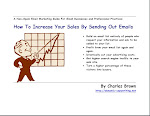
And one more thing. If you would like to learn more about this educational approach to marketing, be sure to download a free copy of my own ebook, How To Increase Your Sales By Sending Out Emails. You will read about other businesses that have gotten excellent results by educating their customers and prospects.
COPYRIGHT © 2008, Charles Brown

 Add to Onlywire
New Ebook For Small Business Owners and Professional Practices
0 comments Posted by Charles Brown at Monday, September 08, 2008I just posted a new ebook I've been working on for small business owners and professionals who need to increase sales or attract new clients.
This new ebook is free and can be downloaded at How To Increase Your Sales With Non-Spam Email Marketing.
I've done a lot of work with lawyers and law firms, as well as "brick and mortor" small business owners, and have seen them spending an inordinate amount of money on useless advertising that produces disappointing results. In response, How To Increase Your Sales With Non-Spam Email Marketing was written to give them the tools of Permission Marketing, email marketing, information products, direct response advertising and direct response web sites.
I absolutely believe that almost all businesses can double their sales using these marketing tools.
So if you are a small business owner or professional who wants to attract more business, be sure to download your free copy. Using these methods, you really can double your sales - and I can prove it.
COPYRIGHT © 2008, Charles Brown
Don't Alienate 69% of Your Potential Clients
0 comments Posted by Charles Brown at Friday, August 29, 2008I just read an article by Erica Stritch in Rain Today that 69% of buyers who are considering hiring a professional services firm will visit a company's web site before making a decision to do business.
This statistic just adds one more compelling reason to make sure your web site delivers the kind of content that will engage and persuade your visitors.
The days of just slapping up a brochure on the web or filling your site with empty "mission statement" language are over (if they ever exited). Whether you are a professional services firm or not, the point is that you cannot afford to make your web site an afterthought.
How can you make your site engaging and persuasive? Here are a few ideas"
- Pay attention to the search terms people typed into a search engine that led visitors to your site. This is a great clue to tell you what people are looking for and what questions they want answered. Make sure your site delivers this information.
- Build your site around what your visitors want to know, what problems they want to solve or what questions they want answered - rather than what you want to sell. Check out my article You're Really Just Selling Aspirin for more on how to do this.
- Make sure the home page offers visitors clear choices to click based on those questions they want answered or problems they want to solve that I mentioned above. It is fine to have product or services choices for those who have already visited your site or who are ready to buy, but most people want information first.
- Do I have to mention benefits? Of course I do because 90% of web sites I visit are written by people who wouldn't know a benefit if it bit them on the nose. If you have trouble distinguishing between features and benefits, substitute "solutions," "answers" or "changes" for the word "benefit."
- Use your site as a lead generation machine. Give visitors a reason a REASON to give you their email address. Offer something valuable and free (usually some information product words best). Most people will not return to your site unless you contact them later with more of the information they sought in the first place.
- What you say in your meta tags does matter. True it has little impact on getting search engine traffic, but it is also what people see when your site comes up in their search results. This will go a long way toward getting them to click onto your site. BUT it also tells them what to expect when they arrive, so don't le them down.
- Include case studies. The actual success stories of your existing customers will not only give people confidence about doing business with you, it will help them understand what you do and what problems you can solve.
None of us can take for granted the importance of our web sites. When over two-thirds of our potential clients check us out online as part of their decision-making process, no business can afford to gamble with a bad impression.
COPYRIGHT © 2008, Charles Brown
Add to Onlywire
Weekly Marketing Tips From Marcia Yudkin
1 comments Posted by Charles Brown at Friday, August 15, 2008Every week I look forward to getting my Wednesday email from Marcia Yudkin when she sends out her Marketing Minute.
I'm not sure if it is accurate to call Marketing Minute a newsletter since, as the name implies, it is a very short, one page marketing idea.
These pithy little ideas have really been helpful to me over time. Not everything applies to what I do, but they almost always stimulate my thoughts and send me off on some tangent of creativity. Many of my articles and blog posts grew out of ideas I have learned from Marcia.
So I really endorse and recommend that you subscribe to Marcia Yudkin's Marketing Minute and give yourself a reason to look forward to your Wednesday email.
COPYRIGHT © 2008, Charles Brown
The Difference Between Writing Web Content and Web Copywriting
1 comments Posted by Charles Brown at Wednesday, August 13, 2008What is the difference between writing web content and web copywriting?
There are two very different styles of writing that you may find on a web site. "Web content" refers to the purely informative text that you may read.
"Web copywriting," on the other hand, refers to the purely persuasive writing that is designed to get a reader to take action (usually to buy something, but sometimes to opt onto a list or subscribe to a newsletter, join a membership or schedule an appointment).
And as with just about everything else in life, there are gray areas between the two. Sometimes they will overlap and often you will see elements of both styles on a single web site.
Let's start by imagining why someone has come to your web site.
Chances are they did not come to be sold something. Except for entertainment and adult sites, most visitors go online to find out information (and since I don't deal with those two exceptions, I'll just talk about the information seekers here).
So we can safely assume that this person who is visiting your site has come to get answers to questions and/or solutions to problems. All of this means that you are a provider of information.
If you provide good information (ie content) to this visitor, you may later have the opportunity to persuade him or her to buy from you (via persuasive copywriting).
The reason for this is that providing good information is persuasive all by itself. Whey you answer questions and educate your visitor, that person will perceive you as an expert and a knowledgeable source. You also build up credibility and trust, which removes many of the objections and doubts a potential buyer might have about you.
On the other hand, some sites do very well with pure copywriting. For examples of this, visit Clickbank.com. Clickbank is a directory of digital products that refers you to one-page web sites that look and feel just like direct mail pieces.
Some of these pages are very well-written examples of pure web copywriting. They promote a single product and give you every reason in the world to buy it. These sites are not about providing information (although they often give you just enough information to arouse your curiosity), they are about selling a product.
And I would argue that there is nothing wrong with this. Many bigger companies that offer a variety of products or services might do well to have such sales pages (that look and feel a little like direct mail pieces) within their sites. After the site has provided lots of content and information, additional links can send visitors to a variety of sales pages to get visitors to take action.
A key to writing for a web site is to mix these two styles together. As you provide informative content, don't make it difficult for the person who suddenly decides to buy. Make sure your "Buy Now" links are clearly visible and have tabs that can lead them to other parts of your site without going back to the home page.
Within a single article you can write informative content and also give your visitors REASONS to take action or buy. You can paint pictures of a better tomorrow if they use your product, you can proactively answer objections and you can begin building agreement that certain solutions are the answers to their problems.
Writing web content and web copywriting are both arts and sciences. But they both begin with understanding who your visitors are and what they want.
COPYRIGHT © 2008, Charles Brown
Learn to Write "Stickier" Home Pages By Reading Cosmo
2 comments Posted by Charles Brown at Monday, August 11, 2008Just today I wrote an email to a potential client who wants to improve her organization's web site. I wrote her that some of the best "patterns" for great home pages are the covers of popular magazines. (Actually web site owners would do well to pattern their entire sites after really popular magazines, but I am only talking about the home page here).
You may laugh, but pick up a copy of Cosmo the next time you are going through your grocery store checkout line. The teaser headlines for the articles inside do two things:
- They arouse intense curiosity, and
- The curiosity the headlines arouse hits readers' "What's-In-It-For-Me" buttons.
Most web sites have a variety of different types of visitors with different needs, questions and wants. Your home page, therefore, should provide links that appeal to each of these needs, questions and wants that lead visitors down pathways which ultimately lead them to take action.
The actions are up to you. They can be to subscribe to a newsletter, opt in to an autoresponder list, request free information, contact your company, or buy right now.
Between the home page link and the desired action is a pathway that I refer to as a "trail of breadcrumbs." Each crumb is a reward to the visitor for staying with you this far. Generally these rewards are problem-solving information, case studies or other interesting and informative content.
Pull out all the stops when developing content for your visitors. David Meerman Scott refers to this as "thinking like a publisher." To go back to the magazine article analogy, if you really know who your visitors are, and what their needs, questions and wants are, you can then produce all kinds of content that appeals to these people.
One of the biggest mistakes though is to limit your content to only things related to what you sell.
Begin at the other end of the transaction. Begin with the people who come to your site, instead of what you want to sell to them.
A great example of this is a public speaker named J.P. Maroney, who was interviewed by Ben Settle at How To Super-Charge Your Marketing With Public Speaking.
When Maroney first started public speaking, he owned a publication that targeted retirees. How he went about selling advertising for this publication is very instructive for any of us developing good web content.
He went to local organizations speaking on the topic of doing business with the senior market. He did not talk about advertising to seniors, but gave business people insights and information about seniors and how to sell to them. What their needs were, how they made their buying decisions, how to build up trust, etc.
At the end of almost every presentation, he had people come up to him to advertise in his publication.
This is the kind of content marketers need to produce more of. We've all seen articles by insurance salespeople about how to select the right car insurance. Such content comes off as self-serving and really only appeals to the person who is actively looking to buy car insurance right now.
But what if the same agent wrote about:
- auto safety,
- how to select car seats for small children,
- safety tips for driving in bad weather,
- what to put into an auto emergency kit,
- how women can protect themselves from predators if their car breaks down at night,
- how to check tires for dangerous wear,
- how to safely change a tire,
- a comparison of the best auto clubs,
- frequently asked questions about auto insurance,
- how to make sure your teenage driver is safe,
- AND how to select the right auto insurance
This agent has written about concerns that affect her potential customers, not just thinly disguised sales information.
In addition, this agent's web site will be a RESOURCE that her target audience will come back to because she produced content that was (cliché alert) outside the box.
So go back to your home page and look at it as the beginning of a trail of breadcrumbs. Lead your visitors down these pathways toward actions by providing them with content that appeals to their needs, questions and wants.
COPYRIGHT © 2008, Charles Brown
Add to Onlywire
20 Free eBooks About Social Media-Courtesy of Chris Brogan
0 comments Posted by Charles Brown at Friday, August 08, 2008For anyone looking for a wealth of information on social media and marketing online, Chris Brogan has compiled a list of 20 Free ebooks About Social Media (I'm thrilled to see my own ebook, The Plot Thickens: Why Case Studies Create New Customers, is listed among such great company).
As one person commented on his blog, "This is a treasure chest." Many of these ebooks are just outstanding and really give some rock solid information.
Check them out.
COPYRIGHT © 2008, Charles Brown
Are Yellow Page Ads Trash? Do They Have To Be?
1 comments Posted by Charles Brown at Thursday, August 07, 2008Larry Bodine, who writes the Law Marketing Blog wrote an interesting piece this week called, Evidence That Yellow Pages Are Trash.
As you probably know, lawyers and law firms are among the most prolific Yellow Page advertisers. Larry mentions that in his local pages, lawyer ads run from page 497 to 538, with little to distinguish themselves other than pictures of gavels and scales of justice.
Sigh. This means I am going to have to get on my lawyer-marketing soapbox again.
As many of you know, I used to be a lawyer and one of my peeves is how poorly lawyers and other professionals market their services.
Frankly I believe this is one of the reasons practicing law is such a high-pressure profession. Poor marketing leads to taking on bad clients with bad cases who leave swaths of stress and frustration in their wake. Many of the cases and clients in a lot of lawyers' files are there simply because they couldn't afford to be selective.
Good marketing enables all professionals to be selective and lets them work with the people they really want to work with.
Back to Larry's article. Larry looked out his window one morning and saw what appeared to be a bag of trash laying in his front yard. When he went out to throw it away, he found it was the local Yellow Pages. His point is that the lawyers who bought expensive ads probably would not have preferred to have it presented as trash in someone's front yard.
I will grant Larry's point that Yellow Pages could be presented much better, but my mind took what he said and went off on its own direction. I believe Yellow Page advertising could be productive for professionals if they were handled better.
Instead of cookie-cutter ads with gavels, scales of justice or pictures of stern looking lawyers, why not use these ads to offer free information kits on different areas of the law?
For example, if I were looking for a lawyer to handle my medical malpractice case, do you think I would be attracted to an ad that listed medical malpractice within a laundry list of other specialties? Or do you think I would gravitate to an ad that offered a free booklet or case study on medical malpractice?
This is the difference between one-step vs. two-step advertising strategies.
Decades of direct response advertising and generations of copywriters have proven that two-step advertising, in which a person merely has to request free information, almost always gets a higher response.
Alternatively, a one-step ad which requires that the person must call a phone number to schedule an appointment, requires much more of a commitment on the person's part, and therefore gets a much lower response.
Two-step advertising requires less of an initial commitment on the part of the potential client, but gives the firm the opportunity to build a list of prospective clients and follow up with these people with subsequent mailings or emails.
These days, the term, Permission Marketing is used interchangeably with "two-step advertising." The ad's sole purpose under this strategy is to gather a list of prospects and follow up with them by offering valuable, free information. Repeated contact with potential clients who have opted onto a list invariably converts more of them into actual clients.
What kind of information can be offered both as the initial inducement to opt in or as follow up material? Problem-solving information pieces like white papers, list articles, FAQs, or case studies all make excellent free info products.
The added benefit with these materials is that they all position the lawyer or other professional as an expert in that area of their practice. They go from someone who just mentioned "medical malpractice" as one of several areas within a laundry list, to someone who is knowledgeable enough to have written material about it.
So, Larry Bodine's point is very well taken that Yellow Page ads may lack a lot in their presentation, but I would urge professionals who do Yellow Page advertising to simply write ads that are intended to build lists of prospective clients.
COPYRIGHT © 2008, Charles Brown
Use Online Videos to Market Your Services
0 comments Posted by Charles Brown at Saturday, May 31, 2008I just read a great article on Patrick McEvoy's terrific blog, Rainmakers' Best Practices, called How to Sue Drug Companies for Free.
The article features a very simple video that was posted on YouTube on May 1, 2007. Briefly, the video is a very simple presentation by a young lady sitting at her desk discussing Defective Drugs and how to sue Drug Companies.
McEvoy says the video has received over 6500 hits in the year it was first posted, and asks lawyers why they don't put up similar videos that explain a legal problem they work with.
Just imagine, he asks his readers, if a simple, five minute video could generate over 6000 people calling their law offices or visiting their web sites? How much new business would that little video create for a lawyer?
What really struck me was how easy it would be for anyone to produce a similar video to market their own business or professional services.
The easiest way to attract new business, is to give away free, valuable information. "How to" articles, white papers, tip sheets or other formats all demonstrate that you are an expert in your field.
But let me also mention another way to produce a simple video if you (like me) are lacking in a lot of technical know how.
I recently discovered that Powerpoint presentations can be converted to videos by using Microsoft Movie Maker. Movie Maker comes loaded on most Windows packages (which means you probably already have it on your computer, even if you don't already know it).
Just take an existing Powerpoint presentation, or create a new one, and turn it into a video with Movie Maker. You can even record your own voice narrating the presentation.
Then you simply upload the video to YouTube, or any of the hundreds of video sharing sites. I bet you will be astonished by the traffic you receive.
Be sure you read Patrick McEvoy's article and watch the video at How to Sue Drug Companies for Free.
COPYRIGHT © 2008, Charles Brown
Case Studies - 3 Steps to a Powerful Marketing Message
0 comments Posted by Charles Brown at Thursday, May 29, 2008What do you find more credible, someone who brags about how their company is "the best," or a third party endorsement by a very satisfied customer of that same company?
It goes without saying, doesn't it, that a third party can give your message far more believability than you could ever give it by "tooting your own horn"?
Third Party Testimonials
Third party endorsements are the ultimate marketing tool, if you can get them.
This is why companies spend so much time and money on public relations. One mention in the media is worth millions in advertising. Not because the exposure reaches more people, but because the impact of being touted by a newspaper, television program or radio show is so much more credible.
Depending on which research study you read, the average American is exposed to over 10,000 advertisements or marketing messages a day. Which begs the question, why in the world should they tune into your message amidst all that clutter?
A third party, who has experienced how good your product or service is, and how helpful your customer service staff is, will be listened to. The hearer knows this is a different message than the typical self-serving promotional material most marketers proclaim.
As a result, this simple message by another party will always cut through more of the clutter than your own message which is always viewed as suspect if it is heard at all.
The Power of a Compelling Story
Now, in addition to the power of a third party singing your praises, what if you communicated your message in the form of a compelling story?
A story with a plot and drama. A story in which one of your customers faced a major problem and your company helped them resolve that problem and achieve a successful outcome?
Stories are powerful. They engage people and draw them in. They allow people to see themselves and their own circumstances in this other person's or other company's struggle to overcome a problem.
So now we have considered the possibility of communicating your message by means of a third party endorsement and a compelling story. What if your message also contained useful and valuable information?
Helpful Information and Expertise
This information could simply be in the form of a few tips on how to solve problems or avoid costly mistakes. It should also contain your company's expertise on solving or preventing such problems for your clients.
In other words, the useful information you convey should demonstrate that your company is very good at what you do without bragging or "tooting your own horn."
So how can you package your message in such a way that it contains a third party endorsement, a compelling story and helpful information?
Case Studies: A Very Powerful Marketing Tool
We are talking here about case studies, also known as client success stories.
I'm sure you have some satisfied customers who are pleased with your product or service. Why not ask them if you can have someone interview them for a case study? As mentioned earlier, the case study will have a plot which consists of the client's problem and how you helped them solve it.
But it should also contain quotes from your customer's key managers who say good things about you. And it should conclude with valuable, practical information from you.
The finished case study should read like a short magazine article, and can then be included in an ad, sent to the media as a press release, or posted on your website. (Read a previous article on this site, Ten Ways to Boost Your Sales With Case Studies, for more ways to promote your business with case studies).
Regardless of the form, you can bet that your case study will cut through a lot of the clutter that bombards your prospective customers each day. The same people who ignore your costly ad campaign will pay attention to a well-written success story.
You will probably find that most of your business clients will be very willing to be featured in a case study. All you really have to do is ask.
COPYRIGHT © 2008, Charles Brown
The Money Making Website: What is the Purpose of Your Website?
0 comments Posted by Charles Brown at Wednesday, May 21, 2008Why is it that some websites and blogs make money and others don't?
I think the key reason is unprofitable site owners do not have a clear focus on what the purpose of their site or blog is.
There are basically two types of websites or blogs:
- A "Branding" Site, is a site that is designed to build your credibility or your "brand."
For someone like myself, who uses this site to build a reputation as a freelance copywriter, a branding site is designed to establish oneself as an expert in a certain field.
The same concept is true for any independant business person, whether you are a lawyer, doctor, consultant, home builder, realtor, etc. Your goal is to establish yourself as an expert in your field.
But for an organization, the purpose of your site is still to build a brand, increase credibility and demonstrate that your firm is an authority in whatever service you offer.
Think about how many sites you see that make empty boasts about how such and such firm is "the best" at whatever they do. Do such ads impart credibility to you?
Probably not, but when you see a site that offers informative articles, free white papers or reports on how to solve a problem that concerns you, do you have any doubts about that company's credibility? In most cases you will find this company highly credible.
In either case, whether you are an individual business person or a company, a branding site must build repeat visitors who keep coming back because you offer valuable information, keep them abreast of new trends, or post "how to" articles that solve certain problems.
Another distinguishing trait of a branding site is that it seeks to generate money from offline business. If you'll pardon me for using this site as an example again, it exists solely to attract clients who want me to write web content, case studies, white papers and other copywriting materials for them.
So the way I do that is to write about things I think will be helpful to my potential clients. Sometimes I may miss the mark, but I always try to think of what problems these businesses want to solve and what information they need.
And over time, based on the feedback you readers give me, I have created a site that is a valuable resource to businesses that need to turn their website visitors into customers, or want to use white papers and case studies to attract more business.
To sum up, a branding site is built upon the principle that them more free, valuable information you give away, the more you will attract new business. - A Traffic Site, on the other hand, makes money by making sales or hosting advertisements online. This site is nothing less than an "online saleperson."
As a result, traffic sites are less dependant upon repeat visitors and more dependant on search engine traffic.
A traffic site usually lives and breathes on ranking high on Google, Yahoo and other search engines for prospective customers to find it. Few traffic sites are designed to attract clients to offline businesses, but instead their purpose is to generate online sales and orders, or get visitors to click on ad links.
Are these two types of websites mutually exclusive? Hardly. A branding site needs to use all the search engine optimization techniques it can in order to rank higher when potential clients do a Google search. Moreover, many branding sites make additional sales by selling products like books or white papers on their sites.
By the same token, traffic sites often provide valuable, problem-solving information to enhance the company's credibility and reputation and to give visitors reasons to return again and again.
But the key here is focus. One of my biggest errors with this site when I first started out was a failure to focus on branding myself. I once had Adsense ads on this site, which only resulted in visitors clicking away to go off to see what someone else had to offer.
One of the best ways I know to prevent a muddled focus is to think about what you want a visitor to do once they arrive on your site.
If you want them to order a product, find ways to display those products with attractive photographs and descriptions of each item.
If you want them to click on your Adsense ads, make sure your site is optimized so the search engines have a clear "understanding" of what type of visitors to send your way. That way the search terms these people typed into Google match the type of ads displayed on your site.
On the other hand, if you want to establish yourself as an authority in your field and get visitors to hire you for offline work, make sure your articles are really informative and give them a reason to keep coming back.
Again, these two types of websites and blogs are not mutually exclusive, but you will find they produce much more business for you if you maintain your primary focus. To use the baseball expression, "It's all a matter of keeping your eye on the ball."
COPYRIGHT © 2008, Charles Brown
How Ashley Alexandra Dupre Became a Millionaire in Two Days
0 comments Posted by Charles Brown at Saturday, March 15, 2008freelance copywriter, Sales letters, ad writer, web content writer, white papers
For those of you just coming out of a coma, Ashley Alexandra Dupre, is the high-priced call girl who is at the center of New York Governor Eliot Spitzer's recent downfall and resignation. She is also a newly-minted millionaire.
It took all of two days for her to go from a call girl to having a bank account of over $1.4 million dollars.
It seems Ms. Dupre is also an aspiring singer, who had two singles available online. When the news hit about her liaison with the governor, the internet gold rush was on to find out all things "Ashley Alexandra Dupre," and people downloaded her songs by the millions.
And although she earned what seems a modest $.69 per download, millions of people downloaded her instant hits before the news cycle began to wane.
So are there lessons here for those of us who market other "products?"
As a matter of fact, yes.
First, although few companies would purposely want to be in the eye of such a publicity hurricane as Ashley Alexandra Dupre finds herself, publicity can reach many, many more people than paid-for marketing efforts.
One way to get free publicity is to piggyback onto a hot news story (as I am shamelessly doing right now in this article).
My favorite, and most dog-eared book on publicity is Marcia Yudkin's 6 Steps To Free Publicity. Simply put, Marcia is a genius, and I say that without reservation. This book will show you how to look for publicity opportunities and how to ride the wave along with them.
Second, appeal to the very human impulse to instant gratification. Ashley Alexandra Dupre had her songs on the internet in a downloadable format, and you can do the same thing.
It is simply a matter of "packaging" your knowledge and expertise in the form of information products. These can be ebooks, tip sheets, white papers, downloadable audio or video files or software programs.
Moreover, your downloadable product can either be free enticements to get your website visitors to opt into your email list, or you could charge for them. (you can already see how quickly $.69 adds up when tied to a lot of publicity).
Riding a publicity wave and offering downloadable info products can be a powerful marketing strategy. I'm sure Ms. Dupre never saw this coming, but if you are nimble enough to tie what you do to a hot news story, you can reap much of the same benefits (without having to hide your head in public).
COPYRIGHT © 2008, Charles Brown
10 Tips For Choosing a Ghostwriter For Your Online Articles
2 comments Posted by Charles Brown at Tuesday, February 06, 2007More and more businesses are discovering that hiring ghostwriters to write online quality articles for them is one of the fastest and best ways to drive traffic to their websites and enhance their professional reputations.
For your own business, you might want to consider this: These online articles, written by ghostwriters, are possibly the best types of links you can get to point to your website. Because the readers have read the articles and clicked on your link, they are highly targeted visitors who want more information about what you can do for them.
In other words, not only does your ghostwritten online article lead visitors to your site, it also pre-sells those visitors by giving them a reason to find out more.
Here are some tips to help you choose the right ghostwriter to help you build your online presence with quality online articles:
- Make sure your ghostwriter knows how to incorporate search engine optimization (SEO) techniques with your article. This means the writer must have an understanding of how to include your targeted keywords into the text so that your articles will be picked up by search engines like Google and Yahoo. There are many ghostwriters who know how to write, but know nothing about how to get high search engine rankings. Choose a writer who can help you get more traffic in addition to writing your article.
- Does the writer know HTML code? Can he or she embed your key words into links in the article so that they point to several different pages on your site? Is that writer’s HTML proficiency enough to make the article’s layout look appealing to a reader’s eye and to avoid making it have a “big block look” with lots of unbroken text. Remember, just publishing the article is not enough if readers don’t read it.
- Make sure your ghostwriter has a track record and samples of articles you can see and read. Has this writer published his or her own articles online at sites like ezinearticles, searchwarp, articlecity, goarticles or any of the other big article banks? Not only will reading this writer’s own articles give you an idea of that person’s writing skills, it will also show that the writer understands the concept of article marketing.
- Can the writer write like a native speaker of the language? Most of the time you will want these articles written in English because this language still dominates most of the article banks and newsletters. Of course a writer does not have to speak English as a primary language in order to write flowing prose. But many people have paid low prices to have an article written by an inexpensive ghostwriter only to receive an article that is written in a choppy, awkward syntax. Again, you can avoid this by seeing the writer’s own articles if he or she has a website and has written articles for the online article banks mentioned above.
- Is the payment arrangement reasonable? The common practice is to pay half the writer’s fee up front and only pay the remaining half after receiving the articles. Understand that the writer still holds the copyright to these materials until you have paid the entire fee, and it only transfers to you when the final payment has been made. But be wary of someone who wants it all up front, just as a writer will understandably be wary of you if you only want to pay after the articles are written.
- Are the ghostwriter’s fees ridiculously cheap or outrageously expensive? You get what you pay for in all areas of life. You should expect to pay a minimum of $50 to $75 for a well-written article with SEO techniques. On the other hand, for a very technical article that requires a lot of research, you should expect to pay as much as $150 or more. Even at the high end of these ranges, you are still getting a very good price for an experienced writer who can often get $1 per word for commercial writing work (these online articles average about 500 words so at these rates you are paying between 10 cents to 30 cents per word). If you go after the bargain basement writer, you will get bargain basement results.
- Does the writer finish the project in a timely manner so you don’t have to wait weeks and weeks for your finished articles? Another reason to check the writer’s status on article banks like ezinearticles is that you will see if this writer is prolific enough to write quality articles quickly and have them back in your hands in time to do you good. Check to see if the writer has achieved special status with the article banks like Platinum Writer or Expert Author. These designations will help you determine if this writer can produce the output fast enough, without sacrificing quality, to suit your needs.
- Does the writer’s fee include re-writing? As long as you gave the writer clear directions about the content you wanted, reasonable rewriting should be part of the fee. As a writer however, I have had to put my foot down on a few occasions when the finished article came back meeting the original instructions given to me and the client just changed his mind and wanted a whole new type of article written. In those rare instances (it has only happened to me twice) I insisted on a new fee for a totally new article. But ordinarily, you should not have to pay more for a little rewriting within the scope of your original instructions.
- Does the writer package the work in a reasonable number of articles? This means, writing several articles on the same topic all at once. I generally feel that a minimum of ten articles on the same topic is needed for the project to pay off for me and for the price to be reasonable for the client. This way, all my research is spread over ten or more articles and I can price my work accordingly. Besides, writing one article at a time will not make a significant impact on the amount of traffic you get to your site. Depending on how much competition you have for that keyword, you will probably need 20 or more before you start seeing significant gains in the number of visitors coming your way.
- Does the writer have an online presence other than just an email address? You want to avoid someone who can only be contacted by email. So you should be able to see an actual website owned by the writer, have a telephone number and be able to read samples of this writer’s other articles. When someone actually has a website, you have more assurance this person is a committed business person who is not likely to take your up front money and disappear. A well thought out website indicates someone who takes a professional approach to being a freelance writer.
Online articles are powerful and fast ways to drive traffic to your website. Working with a good ghostwriter can greatly improve the process and deliver results to your bottom line faster.
COPYRIGHT © 2007, Charles Brown
Do you want to drive more traffic to your website? Do you also want to build a reputation online as an expert in your field?
There is a very simple, low cost way to do both. Write and publish articles online. Hopefully you’ve seen sites like www.ezinearticles.com, www.articlecity.com or www.ideamarketers. These sites are places writers can submit short, 250 to 900 word articles and make them available for webmasters to use for their own websites.
This is the perfect win-win arrangement. The webmasters get free content for their sites, as long as they do not make changes to the articles and give the author a link pointing back to his or her site.
The writers, in my opinion, get a lot more. They get to include a “resource box” at the bottom of their articles that tells readers a little bit about themselves, a link back to the author’s site and the author keeps his or her copyright on the material.
A single article can become a viral marketing tool if it is picked up by dozens or hundreds of other websites. I have one article that is now posted on 167 different websites, and each of those websites now has a permanent link pointing back to my site.
The cumulative effect of writing a lot of articles is enormous levels of traffic to your site. Depending on how competitive your particular niche is, a critical mass level might be 50 articles, or it could be 100. But once you hit that level, you will never have to worry about getting enough traffic to your site.
But what if you have neither the time nor the skill to write these articles? The solution is simple. Hire a ghostwriter. For example, I have had several clients hire me to write articles in their names to post on these sites. I typically charge between $50 to $150 per article, depending on how much research I have to do. In a few cases, the cost has been higher, but those are rare occasions, and the work I had to put in to write those particular articles was quite significant.
If you choose to work with a ghostwriter, you will benefit from the economics of scale. Hire the writer to produce a minimum of ten articles. The research needed to write a dozen or so articles is often not much more than it is for one article. I have found that writing articles for a client in batches allows me to charge fees at the lower end of my fee scale.
COPYRIGHT © 2007, Charles Brown
2007 Prediction: More Professionals Will Use Multi-Step Marketing
0 comments Posted by Charles Brown at Thursday, January 11, 2007This is the year law firms, professionals and service providers finally start seeing real results for their marketing efforts. This will be the year that their advertising, direct mail and websites finally start bringing them the targeted new business and new clients they really want to work with.
How? Because I believe those people who market professional services will finally wake up to the fact that "Multi-Step Marketing" is far more effective than "One-Shot Marketing."
Why One-Shot Marketingwhite Isn't Working For Law Firms or Other Professionals
As a former lawyer myself, most of my attention is focused on marketing ideas for law firms, but what I am about to say is equally applicable to other professionals, service providers and even sellers of products if their expertise is part of the package that comes with their products (large B2B computer systems or software programs would be an example).
One-shot marketing is when you see an ad or visit a website that asks you to contact the company for more information.....and that's it. That simple (and often understated) request for a contact is the only call to action such an ad or website makes.
One-shot marketing gets one, and only one, chance to influence the prospect to act. And if that ad doesn't dramatically reach out and grab the reader's interest, it will be forgotten in 2 seconds.
Look at most of the ads in the Yellow Pages or in business news publications. Do any of them just reach out and grab you that way? Do any of them offer anything really different from their competitors' ads? Rarely.
Why Law Firms and Other Professionals Must Adopt Multi-Step Marketing
As the name suggests, "Multi-Step Marketing" takes advantage of multiple contacts with prospects. When you see an ad, a website or a direct mail piece that offers you a free DVD, CD, white paper, report or ebook on a topic that is currently a source of problems for you, that is the beginning of a multi-step marketing program.
When you request that free information because it sounds relevant to problems you need to solve or changes you want to make, you are "opting in" to the marketer's mailing or email list. This is called "permission marketing" because you are giving that company permission to contact you again. In so doing, you have identified yourself as a prospect with at least some level of interest in what that company does.
If the free information piece you receive from that company is well written and seems to offer a solution to your problem, you may decide to do business with them on the spot. In most cases, this information will help you form the opinion that this company is an expert in this area. It may also position that company as the front runner in your mind in case you ever decide to do business with someone in that field.
But you may not decide to act right now. It is what happens next that truly delivers the remarkable success for multi-step marketers. Over time, you will receive occasional follow up mailings and information. If you weren't ready to do business when you first received the information, your circumstances may change over time.
The long term effect of repeated contacts by the company (because you gave them permission to market to you) is that this company increases its positioning in your mind as THE experts in their field and as THE company you are most likely to do business with when and if you decide to act.
Multi-Step Marketing Helps Law Firms and Professionals Measure Their Marketing Results
Law firms and other professional services have a very difficult time measuring how effective (or not) their advertisements, websites or direct mail really is.
How do you know which calls were produced by your Yellow Page ad, the ad you put in the local newspaper, from your website or from other sources?
Multi-step marketing gives professionals an instant tool to determine how well an ad or website is doing. The number of requests for the white paper, DVD or other information product is the measurement of how effective your ad or website is.
You can even give the same product different titles so you can test whether one ad generates more inquiries than another.
Multi-step marketing eliminates the feeling that advertisers often have of stumbling around in the dark.
Will my "prediction" for 2007 come true? Well I intend to do my part to get the word out to law firms and others who need to hear about multi-step marketing. I'd also love to hear from you. What experiences and recommendations do you have?
COPYRIGHT © 2007, Charles Brown
Lead Generation: The Top Imperative
3 comments Posted by Charles Brown at Wednesday, January 03, 2007What is the one thing your business cannot do without? What one single priority outranks all others?
Whether your business is a small one-man operation or a huge, Fortune 500 behemoth, generating new leads for new business is your single most important imperative.
Without customers or clients, you have no business. And without a constant stream of new leads, you will eventually have no customers.
According to a recent survey, lead generation is the number one goal for businesses in 2007.
Generating leads to acquire customers and drive sales will be top of mind for b-to-b marketers next year.
According to BtoB’s “2007 Marketing Priorities and Plans” survey, acquiring new customers is the No. 1 marketing goal for 2007, cited by 62.3% of respondents.
That said, how are you planning to generate leads for your business in 2007?
Two immediate ideas that can get your lead generation project off to a fast start in 2007 are:
- Create Free Information Products. These can be everything from white papers to tip sheets to ebooks to free DVDs. This strategy recognizes that all buyers go through an information gathering stage in their buying process (the exception of course is impulse purchases, which is a topic for another article). Think about the last time you bought a new car, new house or helped a child choose the right college to attend. You probably looked up a lot of information on the internet, possibly you questioned people who had direct experience with your various possible choices, or you asked the companies for information.
The single caveat of this approach is to avoid selling for your competitors. Don’t just offer information that sells the entire category. If you do that, your reader may choose anyone who offers what you offer. You must sell yourself without being too self-serving in the process ( a fine balancing act, but one that can be done).
Offering free information is a strategy that recognizes that each buyer has a unique buying cycle and procedure. This approach allows you to enter their consciousness at any point along that buying cycle and become a trusted resource for valuable, non-self serving information. - Turn Your Website Into a Lead Generating Machine. It costs most businesses $10 to $20 for every qualified visitor that lands on their websites. I would argue that if you have a choice between getting a visitor to buy something now vs. leave his or her contact information, you are better off getting them to create a lead. When someone has opted in to receive future emails from you (ie “permission marketing”), you have multiple chances to sell and then sell again. This person can become a repeat customer for life. But if you try to hit the home run every time someone visits your site, you only get that one chance to sell and at best may only sell one thing.
Lead Generation is a huge topic and I will revisit this subject many times in the coming year. But for now, I would like to leave you with some resources you will find helpful.
- Brian Carroll writes a blog entirely devoted to the topic of generating b2b leads. He offers a lot of great ideas that you can never keep up with. If you can only put one our of ten into practice, you will do well.
- Michael Stelzner writes a great blog on marketing with white papers. He has also written an excellent book on the same topic called: Writing White Papers: How To Capture Readers and Keep Them Engaged.
- Anne Holland has written a very good article on Marketing Sherpa in which she offers some very practical insights and ideas on how to generate leads.
- Another article by Anne Holland is about lead generation mistakes that get in the way of effective marketing. Anne is nothing if not candid, and her insights are always worth reading. They are also the kinds of mistakes we can all make, so her article is a good cautionary piece.
I’m interesting in hearing about your ideas and insights on the topic of lead generation. What do you think about this topic?
COPYRIGHT © 2006, Charles Brown
Get Every Qualified Visitor to Take Action
4 comments Posted by Charles Brown at Tuesday, December 26, 2006Just like a road trip, a website n must have a specific destination in mind before you start out. When visitors arrives at your site, if you have not painted them a “yellow brink road” to lead them to where you want them to go, they are apt to go just anywhere.
If your website is for business, there are only four possible destinations. Each and every word of content must be written with any or all of these destinations in mind. Your goal must be to lead every qualified visitor to take one of these actions:
- To get the visitor to buy right now. If you are selling merchandise, you should have very clear offers, order forms and promises that lead your visitors to pull out their credit cards right now.
- To get visitors to contact your company to do business or to find out more with doing business in mind. Have your contact information visible on every page (an all too often violated rule) and give visitors REASONS to contact you. What I usually see is content so lacking in tangible benefits, the visitor only thinks, “I’m glad I know about these guys now, if I ever need them, now I know where they are.”
- To get visitors to leave their contact information. This is the heart and soul of permission marketing. Offer visitors something of value like free information, as an ethical bribe to get them to provide their names and email addresses. This destination is to generate leads that you can follow up with future contacts.
- To get visitors to come back to your site. This destination leads them to bookmark your site or subscribe to your feed so they are updated whenever you post new material.
None of this is easy, but if you set up a website aimlessly without purpose, these goals are impossible. As I said before, once you know where you want to lead visitors, write every word of content toward leading them to take these actions.
What are your ideas on this? I’d love to hear any of your examples and insights into this.
freelance copywriter, ghost writer, web content writer, white papers
COPYRIGHT © 2006, Charles Brown
Recently one of the readers of this blog posted a comment about Grant Griffiths, a lawyer in Kansas who has abandoned advertising altogether in favor of writing his blog (thanks Whitney). See the article at Kansas Family & Divorce Lawyer. This is a great article for anyone who sells their knowledge, skill or expertise, because this attorney credits his blog for giving him a number one Google ranking under the keyword, "Kansas family law."
One of the reasons I tend to harp on the flaws I see in law firm advertising in this blog is because I used to practice law. As both a former private practice attorney and a copywriter, I can say that law firms have the worst marketing of any industry or profession I know of.
Whether you are looking at ads placed in the Wall Street Journal by 700 lawyer "blue chip" firms or the Yellow Page ads placed by small main street firms, the ads are almost always dismal. I swear these people wouldn't know a benefit if it came up and bit them on the nose.
And they all follow the same format: "we are a trusted name in admiralty law," "we can get you money if you are hurt in an automobile accident," "we handle cases in elder law, personal injury, corporate law, mergers and aquisitions, DUI defense, etc."
The ads are either empty boasts or laundry lists of the areas of law they practice. (And by the way, you probably won't find the same firm practicing admiralty law, mergers and aquisitions and DUI defense).
So how CAN a law firm market itself effectively without diminishing its professionalism? Easy, write and give out free information pieces.
If you are a lawyer start saving all the memos and briefs you write. Also save your research notes and cases you find interesting as you prepare for court. With few exceptions, these materials can be rewritten for lay audiences and turned into white papers, tip sheets, brochures, articles for your website, or articles you can submit to trade magazines, etc.
You can also start a blog like our friend in Kansas. Write two to three paragraphs a day on your field of practice and in not too many months your site will have a very high number of visitors every day.
Frankly, I would like to see the day when I do at least two-thirds of my copywriting work for law firms. I know from personal experience that it is a wonderful profession when you are working with clients you like and doing the kind of work you believe in. But it is an extremely stressful way to make a living if you have to accept unpleasant clients or take on unpleasant cases just to keep the doors open.
COPYRIGHT © 2006, Charles Brown
Medicare and the Value of Free Information
0 comments Posted by Charles Brown at Thursday, November 16, 2006I have now spent several days helping my retired parents, who are both in their seventies, work their way through the maze of medicare confusion.
For those of you who have not yet experienced this pleasure, U.S. medicare recipients must either renew their medicare plans before December or their previous plan is automatically renewed. Since rates are going up and what is and what is not covered is changing, just letting it renew without study is not an option.
I should also point out that I hold a law degree, and I still find this stuff confusing.
So across the U.S.A., there are puzzled and troubled seniors who need to make an important financial decision within the next month.
Enter the value of free information. Several of the insurance companies that provide supplemental coverage have put out some excellent free information pieces that answer a whole host of questions about the new coverage.
Not only that, one company has also offered a free consultation and is running a spreadsheet comparison of the plans to give my parents a side-by-side comparison of what is covered and for how much.
If you read this blog regularly, you know that I am an advocate of marketing by giving away free information in the form of guides, booklets, ebooks, white papers, seminars, etc.
The marketer who can simplify a complex decision will come out the winner. This is true regardless of whether you sell supplemental medicare coverage or baby formula. Free information makes difficult things more understandable, and therefore removes barriers to buying decisions.
I am looking for examples any of you might have for this. Have you - either as a buyer or a seller - experienced the selling power of free information products? If so, let me know.
freelance copywriter, ghost writer, writing web content, white papers
Great Moments in Wasteful Advertising
2 comments Posted by Charles Brown at Thursday, November 09, 2006Today’s post is about great moments in expensive, wasteful advertising.
I am looking through the November 6-12, 2006 issue of the Fort Worth Business Press for ads that actually give readers reasons to act. As you can imagine, these ads are hard to find.
American Express has a full page ad that does pretty well. It has three benefit statements that say:
“I get a cash rebate of up to 4% on American Express Travel.” I earn company-level award points on all our purchases.” And, “I save automatically with cash rebates from leading suppliers.”
Following these benefits is the headline which reads, “My company is mid-size, but I save big.”
And that’s all. The main feature of the ad is acres and acres of white space with a small blurb at the bottom a picture of the American Express ExtrAA Corporate Card and a Picture of a paper airplane made out of a $100 bill.
I give them credit for actually stating benefits. What a novel idea in big corporate advertising! But the white space? White space never sold anything. Never.
The next wasteful ad is for the law firm of Blaies & Hightower, L.L.P. The only positive thing I can say about this ad is that they only spent money on a half page.
Other than that, it shows three very serious-looking lawyers in expensive suits and six lines of copy that says nothing:
“When the stakes are high, you need more than legal knowledge. … You need the strongest commercial litigation and personal injury trial lawyers on your side. .. Attorneys who lead the courtroom with integrity and honor.”
The sad thing is, someone actually thought these were benefit statements.
Neither ad called for action on the part of a potential customer/client. They gave contact information and that’s all. But that is futile without giving the prospect a REASON to contact them.
Neither ad made a concrete offer. There were no promises of a benefit in exchange for an action from the prospect. The Blaies Camp; Hightower ad was exactly the same as every other law firm ad we’ve ever seen. For all I know, the same serious-looking lawyers appear on all of them. And you just have to love the line, “Attorneys who lead the courtroom with integrity and honor” as a masterpiece of copy that says nothing.
What both these ads need is an injection of direct response techniques. American Express can offer a free guide to corporate financial strategies that would show a corporate officer how to save money on all company expenditures, how to manage day-to-day cash flow and maximize the rebates they offer.
Blaies & Hightower could offer a report, a case study or a white paper on any one of the areas of law the practice. These could contain tips on how to avoid litigation, what new government regulations effect businesses or how to profit from recent trends in the law.
By offering free information products, neither firm would diminish the brand image they are striving for (and actually in my mind, they would stand out in a positive way). But not only that, these white papers, guides or booklets could generate leads and build a list of potential customers/clients for these firms.
The sad truth is both these ads were incredibly wasteful. White space sells nothing and copy that says nothing, sells nothing. Better luck next time guys.
COPYRIGHT © 2006, Charles Brown

